
Daily Tech: Catalysts in Focus: FDA, Uranium, AI-Biotech, and Spectrum Deals Drive Market Moves
FutureGate | August 27 2025
Centrus Energy (LEU) Gains on Uranium Enrichment Expansion
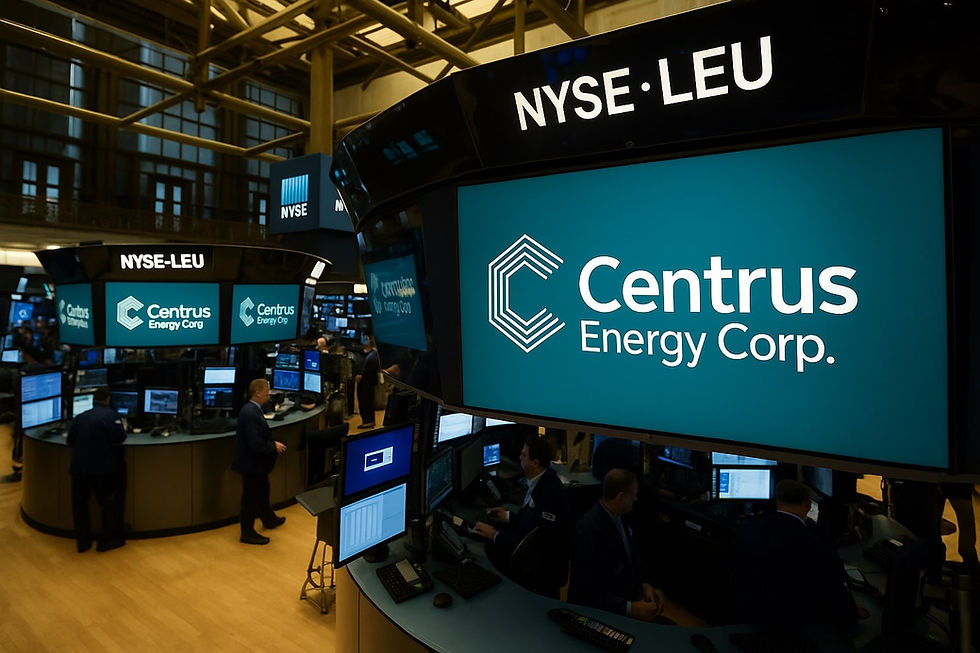
Centrus Energy surged after signing an agreement to explore investment to expand its U.S. uranium enrichment capabilities. This comes at a pivotal time: Western nations are rebuilding nuclear supply chains to reduce dependence on Russia, which still controls ~40% of global uranium enrichment. Centrus already operates the only U.S.-licensed HALEU (High-Assay Low-Enriched Uranium) production facility, positioning it as a strategic supplier for both advanced nuclear reactors and defense programs.
From an investor standpoint, expansion could unlock long-term recurring revenue streams, particularly as the U.S. Department of Energy prioritizes domestic nuclear fuel security. However, the capital intensity of scaling enrichment and potential regulatory hurdles remain key risks. If successful, Centrus could see valuation re-rating as the market begins to price in U.S. government-backed demand.
Outlook Therapeutics (OTLK) — FDA Decision Looms on Wet AMD Therapy
The FDA is expected to rule today on Lytenava (bevacizumab-vikg), Outlook’s lead therapy for wet age-related macular degeneration (AMD), a market worth ~$13B annually in the U.S. The drug aims to become the first FDA-approved on-label ophthalmic bevacizumab, competing directly against Genentech’s Lucentis, Regeneron’s Eylea, and Roche’s Vabysmo.
If approved, Lytenava could disrupt the market by undercutting branded biologics on cost while offering payers and physicians a legally approved alternative to off-label Avastin.
For investors, this is a binary catalyst: approval could unlock significant upside and near-term licensing opportunities.
Fifty1 Labs & Lunar Aerospace: AI-Driven Drug Repurposing for Space Health
Fifty1 Labs and Lunar Aerospace (LUNR) announced a partnership targeting AI-based drug repurposing for astronaut healthcare. The goal is to identify new uses for existing drugs to address unique challenges in spaceflight, such as bone density loss, immune dysregulation, and radiation exposure. By leveraging AI algorithms with access to orbital biological research, the collaboration seeks to accelerate drug development in an environment where traditional R&D is costly and slow.
While still early stage, the collaboration highlights a novel convergence of biotech, AI, and space exploration. Investors should view this as a long-duration call option: near-term revenues are unlikely, but the potential for NASA, SpaceX, or DoD contracts could provide significant non-dilutive funding. If proven viable, the platform may also have terrestrial applications in rare disease or oncology, broadening the addressable market.
EchoStar (SATS) Skyrockets on $23B AT&T Spectrum Deal; Tie-Up Speculation Rises
EchoStar (SATS) soared more than 70% after announcing a $23 billion spectrum lease agreement with AT&T, spanning over 400 U.S. markets. The deal effectively monetizes EchoStar’s underutilized spectrum assets, transforming them into a stable revenue stream while positioning the company as a more valuable partner in the U.S. telecom landscape.
The rally extended in after-hours trading amid speculation that T-Mobile (TMUS) and SpaceX’s Starlink could pursue a broader partnership involving EchoStar’s assets. Such a scenario would accelerate convergence between satellite and terrestrial networks, opening new avenues for connectivity in underserved regions.


Comments